Public
Hackathon landscape analysis
Python pipeline that scraped, structured, clustered, and scored 4496 projects from the Gemini API Developer Competition on Devpost. Findings published as a LinkedIn post.
TL;DR
- Multi-stage pipeline: scrape → structure → cluster (TF-IDF + KMeans) → score → AI narrative (Claude).
- 4496 projects analyzed; 4292 scored (95.5% success rate).
- Key finding: Developer Tools and Health scored highest; Media/Creative most crowded and least differentiated.
- Findings published as a LinkedIn post; analysis also informed product positioning for a later project.
Reusable patterns
- Multi-stage pipeline with raw artifact preservation: each stage is resumable and independently debuggable.
- TF-IDF + KMeans as fast baseline for domain clustering on short text (project descriptions).
- Custom scoring rubric (innovation, impact, scalability) as a proxy for "interesting" before reading full docs.
- State tracking (meta.json) for resumable scraping: restart a long run without re-fetching already-scraped pages.
- Claude API for narrative deepening: LLM adds qualitative insight on top of quantitative cluster outputs.
Context
The Gemini API Developer Competition on Devpost received 4496 project submissions, too many to read manually.
Goal: understand the landscape systematically: dominant domains, under-served areas, technology signals, and award candidates.
Decisions
- Multi-stage pipeline (fetch → structure → analyze → deepen): each stage writes outputs to disk before the next one starts; failures are cheap and runs are resumable.
- Retry + jitter in the scraper (6 attempts, 0.7s ± 0.15s delays): steady throughput without triggering rate limits.
- TF-IDF + KMeans for unsupervised clustering: fast, interpretable, no labeled data needed.
- Custom scoring rubric: weighted composite of innovation, impact, and scalability signals extracted from project text.
- Claude API for Phase 2 deepening: the quantitative pipeline surfaces structure; Claude adds narrative and qualitative context.
Architecture
- fetch: scrapes gallery index pages + project detail pages with retry, jitter, and raw HTML preservation.
- structure: normalizes JSONL into master table, extracts tech tags, links (repo/demo/video), team members.
- analyze: TF-IDF + KMeans (18 clusters), domain rule classification, composite scoring, award candidate nomination.
- deepen (Phase 2): Claude API generates narrative summaries on top of quantitative clusters.
- All intermediate outputs written to disk (dump/, structured/, analysis/); the pipeline is fully resumable at any stage.
Outcome
- 4292 of 4496 projects scored (95.5% success rate).
- Key finding: Developer Tools (avg score 55.9) and Health & Wellness (55.6) were the highest-quality domains; Media/Creative Tools (48.5% of all submissions, avg 46.6) was the most crowded and least differentiated.
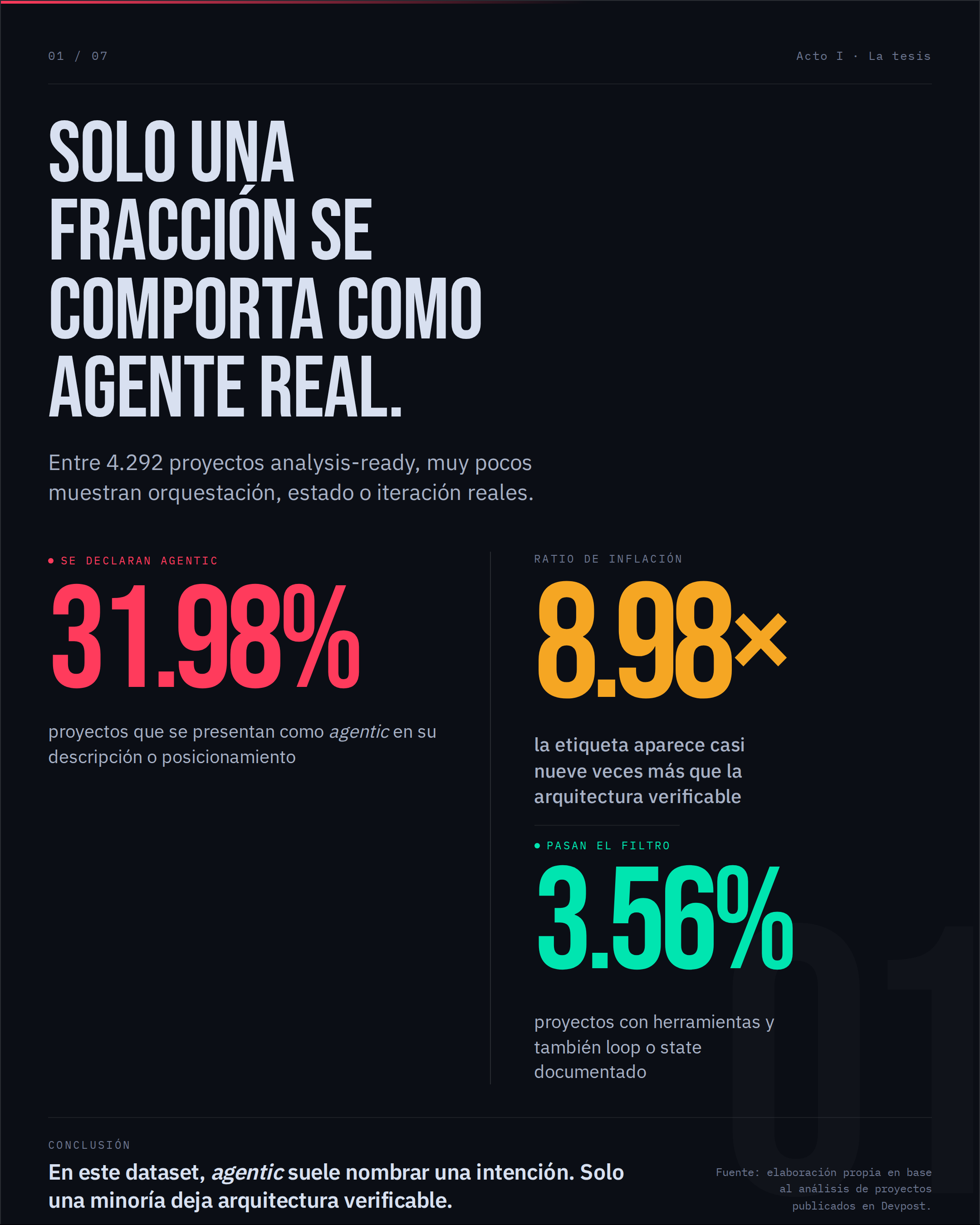
- 31.98% of projects agentic; 32.25% multimodal, identified as emerging capability clusters worth tracking.
- Findings published as a LinkedIn post; analysis also used for competitive positioning in a later product.
Links
Slides
1 / 7