
Redacted UI preview (no names or amounts).
Private (redacted)
Public procurement tooling (redacted)
Private engagement: pipeline + app that turns tenders and awards into decision-ready data. Screens are redacted; no names or amounts.
Constraints
- Client and contract details are under NDA (no names, amounts, or identifiers).
- Screens are redacted and show structure only (not operational data).
- I can discuss architecture, data model, validation, and workflow.
TL;DR
- Private pipeline + analytics app for procurement tenders and awards (redacted).
- Solved inconsistent schemas and drift across sources with validation, deduping, and traceability.
- Built a canonical analytics model + matching workflow and shipped an action-oriented UI with exports.
Reusable patterns
- Canonical analytics model that unifies messy source schemas into stable entities.
- Ingestion hardening: validation, deduplication, and change tracking for schema drift.
- Traceability-first logging so every number can be explained back to source.
- Deterministic matching rules + assisted review for entity/classification resolution.
- UI patterns for ops: essential filters, exports, and repeatable reporting.
Context
In procurement, information is scattered across sources with inconsistent schemas and fields that drift over time.
The goal: a coherent view for analysis, monitoring, and reporting, with auditability and traceability.
Note: under NDA, names, entities and amounts are omitted; visuals are redacted.
Decisions
- Canonical analytics model (contracts, suppliers, items, timelines, awards).
- Robust ingestion: validation, deduplication, and change tracking to handle schema drift.
- Supplier/classification matching with deterministic rules + assisted review.
- Action-oriented UI: essential filters + export for recurring reporting.
Architecture
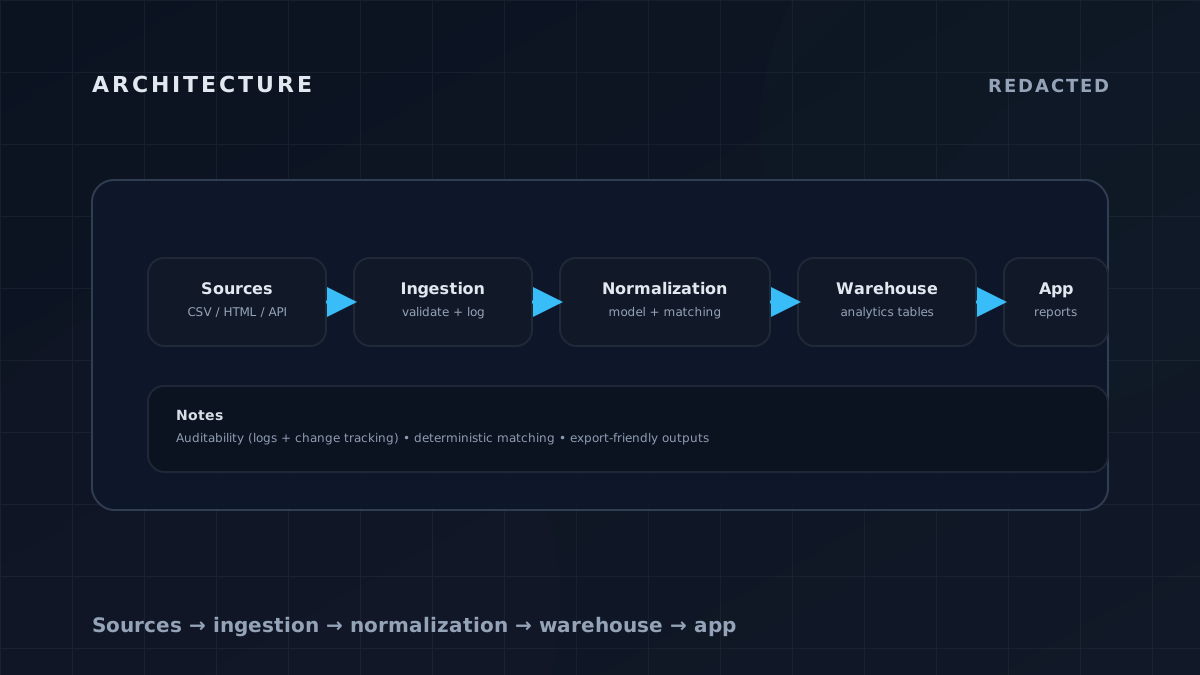
- Logging and traceability to explain where each number comes from.
- Clear separation: ingest/validate, transform, analytics model, UI/reporting.
Outcome
- Lower friction for supplier, timeline, and award analysis.
- Consistent entities and classifications over time.
- Reusable base for audits, alerts, and recurring reporting.