Public Economics
Why Chile does not quantify the fiscal risk of its disasters (and Spain does)
Executive summary
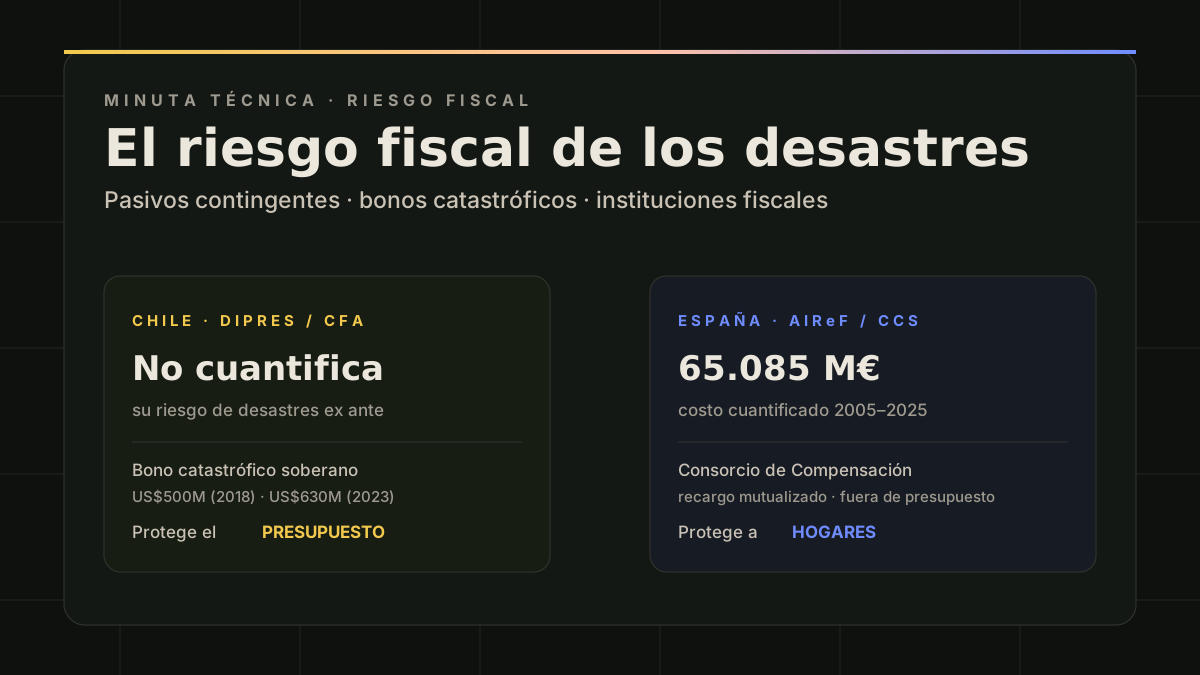
Chile is one of the most seismically exposed countries in the world and has one of the strongest fiscal architectures in Latin America. It documents the cost of each catastrophe in detail once it has occurred, through reconstruction plans, financing laws, and execution reports. Yet it publishes no forward-looking estimate of the expected fiscal cost of future disasters. Its Budget Office quantifies the State's explicit contingent liabilities in detail and deliberately excludes disasters from its risk report, for fear of fueling bailout expectations. Spain, far less exposed, did the opposite: in June 2026 its independent fiscal authority put the cost of disasters and other extreme events between 2005 and 2025 at €65.085 billion, and recommended booking it in the budget before such events occur.
The gap is not explained by technical capacity or by a lack of instruments. Chile already transfers its sovereign seismic risk to the markets through catastrophe bonds, but it still publishes no equivalent measurement and has no mechanism to spread the cost across households before the blow. Closing that gap would require adding a disaster chapter to DIPRES's annual report, declared as a stress exercise rather than a legal commitment.
1. The paradox
On 27 February 2010, a magnitude 8.8 earthquake lifted central-southern Chile. The State documented the blow with remarkable precision: losses estimated at around US$30 billion, a US$8.431 billion reconstruction plan, and a public breakdown of how it would be financed, sovereign fund and tax law included. The same happened with the northern earthquake in 2014 and the Valparaíso fires in 2024. Each catastrophe left behind a costed reconstruction plan, a financing law, and execution reports.
Chile tallies what a disaster costs once it has happened, but does not estimate in advance what the next one would cost. The country's fiscal-risk report publishes no figure for the expected cost of future catastrophes.
The contrast is striking. Chile ranks among the most seismic countries on the planet and has one of the most respected fiscal architectures in the region: a structural balance rule, sovereign funds, a Budget Office that models its commitments down to hundredths of GDP, and an autonomous fiscal council created in 2019. It even buys seismic protection in financial markets, an operation that requires modeling an earthquake's probable loss in advance. Although the capacity to estimate the risk exists, the fiscal report does not include the figure.
Spain took the opposite path. In June 2026, AIReF published a figure few governments want to see in writing: natural disasters and other extreme events cost the Spanish State €65.085 billion between 2005 and 2025. The DANA floods that hit Valencia in 2024 alone account for more than €12.2 billion. AIReF paired the figure with a concrete recommendation: build a database of the fiscal cost of catastrophes and start recording that cost in the budget before it occurs.
2. What Chile measures and what it leaves out
The starting concept is the contingent liability: a bill the State pays only if something happens. A government-backed student loan is the textbook case: while the borrower pays, it costs nothing; the day they default, the treasury steps in. Earthquakes fall into the same category, with an uncomfortable nuance. No one signed a contract obliging the State to rebuild the country after a quake, but everyone, including citizens and markets, takes for granted that it will. The State acts as insurer of last resort without having issued any policy.
Contingent liabilities split into two families depending on whether a formal commitment exists. That distinction is what marks the boundary of what Chile reports.
| Explicit liabilities (legal or contractual commitment) |
Implicit liabilities (social or political expectation) |
|---|---|
| Deposit guarantee | Post-disaster reconstruction |
| Government-backed loans | Uncommitted bailouts |
| Public-works concession guarantees | |
| Lawsuits against the treasury | |
| Quantified: 10.36% of GDP in 2024 | Post-disaster reconstruction: no ex-ante estimate in the risk report |
Part of sound fiscal management is measuring these latent bills. Each year, DIPRES publishes a Contingent Liabilities Report that precisely quantifies the State's explicit commitments. Its coverage, however, stops there.
| Commitment | Quantified? | Exposure (2024) |
|---|---|---|
| State deposit guarantee | Yes | 4.15% of GDP |
| Government-backed loans (CAE) | Yes | 1.55% of GDP |
| Guarantee on public-enterprise debt | Yes | 0.75% of GDP |
| Lawsuits against the treasury | Yes (probabilistic) | 0.30% of GDP |
| Revenue guarantees on concessions (MOP) | Yes (probabilistic) | ~0.02% of GDP (flow) |
| Post-disaster reconstruction | No | No published estimate |
The report not quantifying disasters does not mean Chile ignores their cost. After each catastrophe, the State funds and budgets reconstruction in full detail: the 27F plan came to US$8.431 billion, and the 2024 Valparaíso fires plan exceeded US$1 billion, financed by a transitory fund created by law. What is absent is an estimate, made before the disaster, of how much future ones can be expected to cost. DIPRES recognizes spending after the event but does not quantify the risk in advance.
DIPRES classifies disasters as an implicit liability and deliberately excludes them for a specific reason.
3. The prudence argument
For the Budget Office, putting in writing how much a major earthquake would cost has an unwanted side effect: it cements the expectation of a bailout. If citizens, firms, and regional governments know the Finance Ministry has a line item calculated for catastrophes, they insure themselves less, invest less in prevention, and prepare worse. The published figure becomes a promise, and the promise relaxes everyone. This is the classic moral hazard of insurance: the more generous the coverage looks, the less care the insured takes. The objection targets the prior estimate, not the subsequent spending: paying for reconstruction after the blow was never in doubt; what is avoided is fixing the risk number in advance.
The argument is reasonable, but estimating the expected cost of a disaster does not create a legal debt. Other countries publish the estimate without making that commitment. Colombia includes a disaster chapter in its fiscal framework and models the probable maximum loss of its public portfolio. The Dominican Republic publishes a fiscal-risk report with a climate-and-disasters section. New Zealand maintains a public seismic insurer and reports its exposures to parliament. These precedents show that available methods can disclose the risk without turning the estimate into a bailout guarantee.
4. Chile already buys earthquake insurance
Chile does not ignore seismic risk in its treasury. For years, it has transferred that risk to financial markets through catastrophe bonds.
A catastrophe bond works like insurance sold to investors. They put up the capital and collect a high interest while nothing happens. If an earthquake meeting predefined magnitude and location parameters occurs, they lose their money and the State receives it immediately to fund the emergency. Chile placed its first such bond in 2018 and repeated in 2023 with the largest operation the World Bank had ever structured for a single country.
| 2018 | 2023 | March 2026 |
|---|---|---|
| First cat bond US$500M Pacific Alliance |
Second cat bond US$630M bond + swaps |
Coverage expires renewal unconfirmed |
Chile does protect its sovereign budget against a mega-quake. The bond covers the treasury's balance sheet, but not families or small firms. That exposure still falls on the budget when disaster strikes.
5. What changes in Spain
Spain solves precisely that tranche with a piece Chile lacks: the Insurance Compensation Consortium (Consorcio de Compensación de Seguros). The Consortium adds a small surcharge to every private home or auto policy and, with that common fund, compensates the affected directly when a catastrophe hits, without going through the budget and without waiting for a disaster zone to be declared. When the DANA struck, the Consortium paid out around €4.2 billion that would otherwise have landed on the public accounts.
The headline figure AIReF published is better understood broken down. A large share corresponds to the extraordinary pandemic response; the rest, to emergency works, aid to the affected, and payouts from the public insurer.
| Component | € million | Share |
|---|---|---|
| Extraordinary response (COVID and others) | 35,785 | ≈ 55% |
| Emergency works and aid | 16,500 | ≈ 25% |
| Insurance Consortium payouts | 12,800 | ≈ 20% |
| Cumulative total | 65,085 | 100% |
Both countries use sophisticated financial instruments, but differ in how they publish the figures and distribute the cost of catastrophes in advance.
6. The full map: risk layers
Disaster financing is usually organized in layers, according to the frequency and severity of events. Small, frequent events are covered by retaining own resources; large, rare ones are transferred to third parties; whatever exceeds all that is left to international support. Chile and Spain cover the same layers with different instruments, especially in the second.
| Layer | Chile | Spain |
|---|---|---|
| 1 · Retention frequent, minor events |
Emergency line · 2% constitutional · FEES | Contingency Fund |
| 2 · Transfer extreme tail |
Sovereign cat bond protects the budget |
Insurance Consortium protects households and firms |
| 3 · External support | IDB · World Bank | EU Solidarity Fund |
The asymmetry is in Layer 2. The Chilean cat bond and the Spanish Consortium occupy the same place on the map, but protect different subjects: the first shields the State's balance sheet and the second, the citizen. After a mega-quake, Chile would have budget coverage, but uninsured households would depend on public transfers. In Spain, compensation comes from an off-budget fund.
The transparency gap also remains: Spain quantifies and publishes; Chile does not.
| Dimension | Chile | Spain |
|---|---|---|
| Quantification of disaster risk | Not published (declared implicit) | €65.085bn cumulative, 2005–2025 |
| Integrated fiscal-risk report | Partial (explicit liabilities only) | Yes (AIReF Opinions) |
| Sovereign tail transfer | Cat bond (US$500M 2018; US$630M 2023) | Reinsurance and state backing of the Consortium |
| Mutualization of household risk | Does not exist | Insurance Compensation Consortium |
| Role of the independent fiscal institution | CFA: macro-fiscal; recommends studying climate | AIReF: quantifies and recommends provisioning |
| Integration in the budget cycle | Low (ex-post reallocations) | Medium (fund within spending ceilings) |
7. Two fiscal councils, two habits
Spain and Chile share an institution that was scarce in the region a decade ago: a technical, independent body that watches the public accounts and says aloud what the government of the day would rather keep quiet. In Spain it is AIReF; in Chile, the Autonomous Fiscal Council (CFA). Although their credibility is comparable, they have adopted different practices.
AIReF decided that quantifying disaster risk fell within its work, and did so even knowing its figures were imperfect. The CFA focuses on the macro-fiscal: the structural balance rule, the debt trajectory, the revenue projection. On climate change and catastrophes its intervention has been more cautious; in its minutes it limits itself to recommending that the Finance Ministry study the matter, but publishes no measurement of its own.
That difference is not a technical limitation. The CFA demonstrated its capacity in May 2026, when it analyzed the government's Reconstruction Bill and calculated that the initiative would worsen the fiscal balance by up to 0.71% of GDP in 2030 if the promised growth did not materialize. The council knows how to estimate the fiscal impact of a complex law several years out. Applying that same machinery to earthquake risk is a step it has not yet taken.
8. Why the missing number matters
A large disaster affects the public accounts in a chain. Emergency and reconstruction spending requires the State to issue debt; higher debt pressures the credit rating and can raise the cost of all of the country's future financing, not just reconstruction.
Major disaster → Emergency and reconstruction spending → Debt issuance →
Pressure on the credit rating → Higher cost of country financing
… which raises the cost of all future debt and feeds the cycle back.
The CFA itself measured a smaller version of this effect during the reconstruction-bill debate: the legislative process alone, with no earthquake involved, already strained the perception of country risk. Measuring the expected cost of catastrophes makes it possible to anticipate that chain and decide in advance how much to retain in a fund, how much to transfer to markets with a bond, and how much to leave to household insurance. Without the figure, every disaster is managed as a budget surprise and financed with whatever is at hand: reallocations, emergency debt, sovereign-fund withdrawals. It works, but it is expensive and opaque.
9. Who already does it
Chile would not be inventing anything by quantifying. Several countries in its region and in the OECD already integrate disaster risk into their fiscal reports, with varying degrees of depth.
| Country | Reporting vehicle | Quantifies disaster risk? |
|---|---|---|
| Spain | Fiscal Risk Opinions (AIReF) | Yes, historical cost and breakdown |
| Colombia | Medium-Term Fiscal Framework | Yes, with probable maximum loss |
| Dominican Republic | Fiscal Risks Report | Yes, climate-and-disasters chapter |
| New Zealand | Statement of Fiscal Risks | Yes, public-insurer exposure |
| Philippines | Fiscal Risk Statement | Yes, with cat-bond coverage |
| Chile | Contingent Liabilities Report | No |
10. A limited reform
The reform can be limited: add a disaster chapter to the Contingent Liabilities Report with a probabilistic estimate, starting with seismic risk, the country's best-modeled hazard. The report would need to state explicitly that the figure is a stress exercise rather than a legal bailout commitment. SENAPRED already has hazard maps; DIPRES and the CFA have modeling capacity. The World Bank and the IDB have offered technical support for this type of analysis for years.
Chile knows its seismic risk and partly covers it in international markets. Yet its risk reports do not estimate the cost of the next disaster in advance, for fear of the expectations that figure could raise. Spain, with fewer earthquakes, publishes and debates that figure. Chile could adopt the same practice by adding a new chapter to the report DIPRES already publishes every year.
Methodological note
This document consolidates four independent investigations generated with different language models and submits their quantitative claims to verification against primary sources or specialized press. The figures in the body (AIReF costs, the DIPRES liabilities stock, the CFA analysis of the reconstruction bill, and Chile's catastrophe-bond issuances) are verified. During consolidation several unsupported claims were discarded, among them the existence of a supposed Chilean disaster fund and a climate scenario attributed to AIReF that no source backs. One open point remains: the amount actually reimbursed to Spain by the EU Solidarity Fund after the DANA, distinct from the eligible spending claimed.
Main sources
- AIReF, Second Opinion on Fiscal Risks (June 2026) and Opinion on Fiscal Risks (March 2025). airef.es.
- Insurance Compensation Consortium: legal framework (RDL 7/2004) and the mandatory surcharge. consorseguros.es; boe.es.
- DIPRES, Contingent Liabilities Report (2024 and 2025) and Public Finances Report. dipres.gob.cl.
- Government of Chile and MINVU, ex-post reconstruction plans as evidence of budgeting: 27F Program (losses ~US$30bn; US$8.431bn plan), 2014 Northern Earthquake, and the 2024 Valparaíso Plan with the Transitory Emergency Fund (Law No. 21,681). minvu.gob.cl; planreconstruccion.cl.
- Autonomous Fiscal Council, presentation to the Finance Committee on the National Reconstruction Bill (May 2026). cfachile.cl.
- World Bank, Pacific Alliance catastrophe-bond issuances (2018, US$500M) and Chile (2023, US$630M). worldbank.org.
- IMF, Fiscal Transparency Code and Analyzing and Managing Fiscal Risks (2016). imf.org.